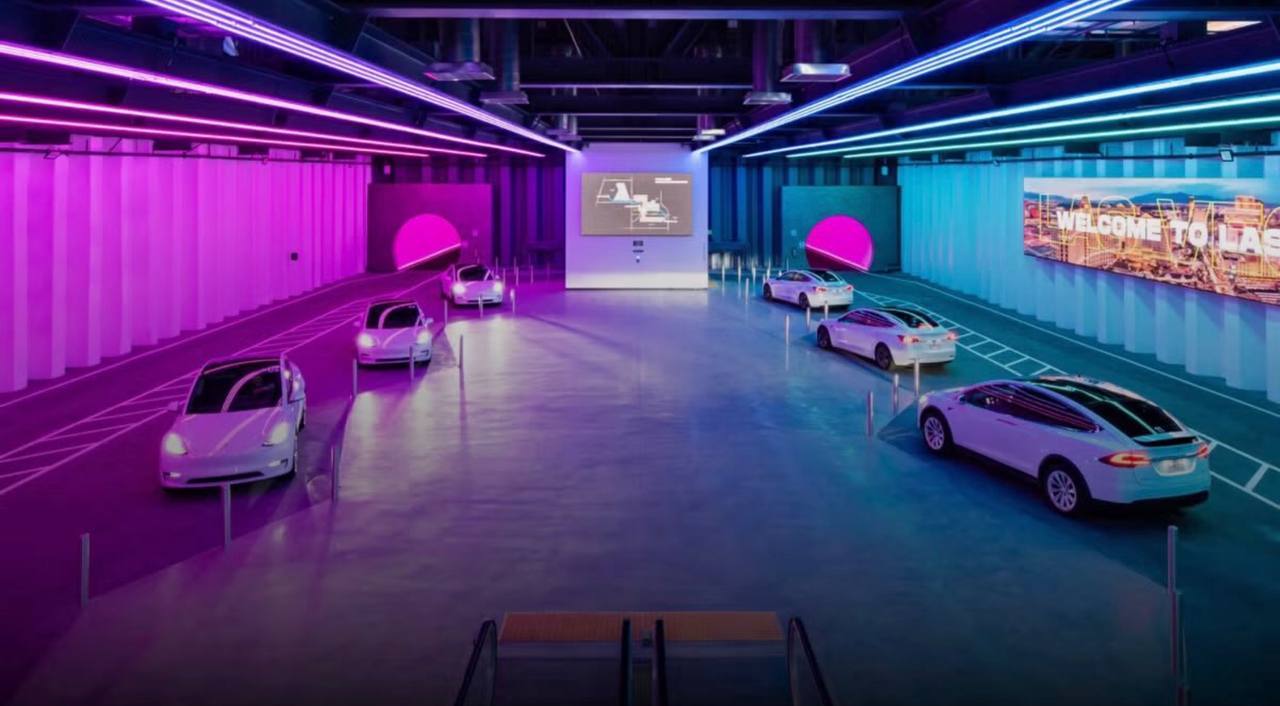
The Boring Company director Mike Baier spent Monday evening on X handing out the kind of specifics the tunneling firm rarely volunteers: the Vegas Loop moves about 40,000 passengers on a busy convention day, the airport connector tunnels open in a few months, and ridership should triple or quadruple when they do.
Baier, the company’s Director of Production, Electrical Engineering, and Software Engineering, made the claims in a thread posted at 6:48 p.m. Eastern on July 27 that drew 35,000 views and 1,600 likes within hours. He kept answering questions well into the night, covering tunnel costs, boring speeds, Full Self-Driving coverage, and fares of $4.50 per ride or $13 for a day pass.
The peak-day figure, he argues, beats most American light rail systems. He’s right. He’s also comparing his best day to everyone else’s average one, and that gap is the real story.
The Airport Connector Timeline Keeps Sliding To The Right
The 2.25-mile Airport Connector twin tunnels, which Boring Company president Steve Davis targeted for a first-quarter 2026 opening back in December, remain under construction in late July, and Baier’s new guidance of a few months pushes the opening toward the end of the year at best. Once open, he expects ridership to grow 3x to 4x, which would put the Loop, by his math, in the top 10 of US public transportation systems and eventually the top 3 or 4.
The Las Vegas Review-Journal reported in December that Davis promised airport rides in the first quarter, with the system handling 17,000 to 20,000 people per hour once the line opened. The company has been running above-ground airport trips through partial tunnel routes since late 2025 while it finishes digging. As of a July 18 Review-Journal report, the company was still boring toward a site just north of Harry Reid International Airport, with a direct airport station under discussion but not yet agreed.
Baier called the connector twins two of the longest transportation tunnels built in the US in the past 25 years. The full approved build-out remains 68 miles of tunnel and 104 stations across Clark County and the City of Las Vegas, against roughly a handful of miles open today through 11 stations.
Baier Concedes The Machines Run At A Quarter Of Their Paper Speed
Tunneling costs the company between $5 million and $10 million per mile depending on ground conditions, Baier wrote, and its Prufrock machines currently manage about a mile per month against a design spec of roughly a mile per week, an admission of a 4x gap between marketing and reality that executives in the Musk orbit almost never make in public. The fix, in his telling, is logistics and reliability work, not a redesign.
That candor matters because the mile-a-week number is load-bearing across the company’s expansion pitch. When EVXL covered the start of Nashville Music City Loop tunneling on February 25, the Prufrock-MB1 machine’s target of better than a mile per week was the basis for the company’s aggressive Q1 2027 opening estimate on a 13-mile route. At the mile-a-month pace Baier now describes as actual, that math changes by years, not weeks.
Baier also argued the machines are reusable, so every unit that leaves the line adds annual capacity, and he sees a path to hundreds of miles per year sooner than skeptics expect. One reply asked for a machine per week. His answer: on it.
FSD Covers Only Some Routes While Cybercabs Wait Next Door
A rider who took six Loop trips this week reported that none used Tesla Full Self-Driving, and Baier’s explanation was that FSD simply doesn’t support every route yet, nine months after the company began supervised FSD trials in the tunnels in October 2025. Route-by-route rollout in a closed, mapped, single-operator tunnel system is a slower crawl than the environment would suggest.
The obvious next question came up too: when do Cybercab robotaxis enter the tunnels? That one had no visible answer from Baier in the thread, but the pieces are moving around him. Tesla’s July 22 Q2 earnings named Las Vegas as one of the next two robotaxi metros, as EVXL noted in today’s Charlotte staging report, and the company has 245 finished Cybercabs parked at Giga Texas looking for somewhere to earn a fare. A geofenced tunnel network in a robotaxi launch city is about the friendliest deployment surface that inventory could ask for.
EVXL’s Take
Baier’s thread is the most useful public accounting of the Vegas Loop in months, and I want to give him credit for the mile-a-month admission before I take the rest apart. A director at a Musk company voluntarily stating that real-world output runs at a quarter of the design spec is rare honesty, and it’s worth more to me than any ridership boast.
Now the boast. The 40,000-rider figure, which Baier wrote is “more than the majority of light rail systems in the US,” checks out on its face: Houston’s METRORail, the tenth-busiest light rail system in the country, averages about 35,100 weekday riders, so a 40,000-passenger day genuinely beats the average weekday of most American light rail. But that’s the trick. Convention-day peaks are the Loop’s Super Bowl, and Baier is scoring them against everyone else’s Tuesday. The Boring Company’s own project page counts more than 4 million total passengers through 11 stations since the system opened in June 2021. Spread over those five years, that averages out to roughly 2,200 rides per day, and even weighting the count toward the busier recent years, the typical day sits in the low thousands. On its typical day, the Loop wouldn’t crack the top 25.
None of that makes the Loop a failure. It makes it a convention shuttle with genuine peak capacity and a thin base load, which is exactly what a system anchored to a convention center should look like, and the airport connector is the one addition that could actually change the base-load math. That’s why the slipping timeline is the number to watch, not the ridership. Davis said Q1 2026. It’s late July and Baier says a few months. Given that track record, I’ll take the under: paying passengers ride the full underground airport route closer to Q1 2027 than to Halloween. When those tunnels open, the ridership claims stop being marketing math and start being measurable. I’ll be checking.
Source: Mike Baier on X, Las Vegas Review-Journal, The Boring Company
EVXL uses automated tools to support research and source retrieval. All reporting and editorial perspectives are by Haye Kesteloo.