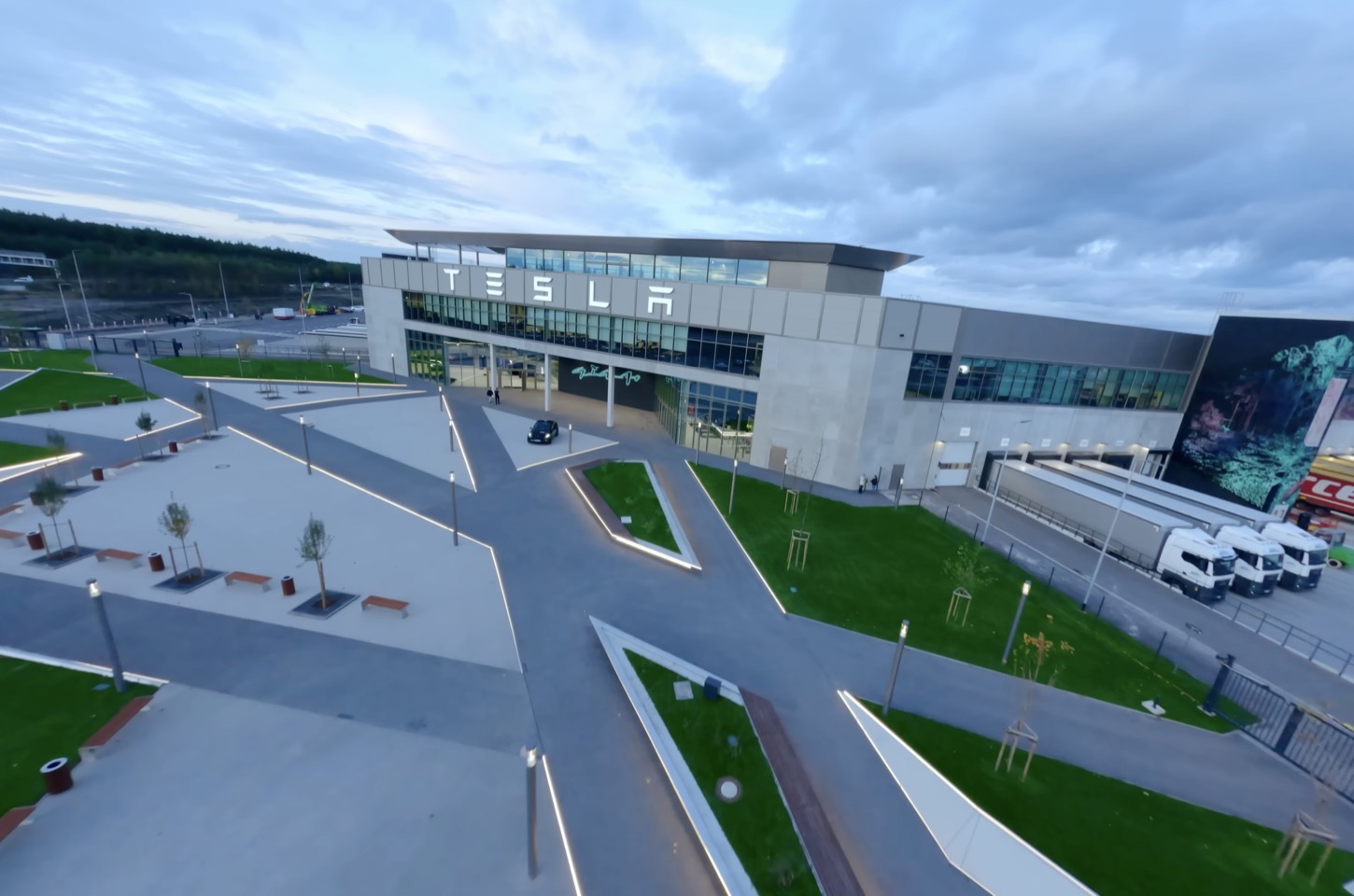
Tesla’s German factory operated at 54% of capacity in 2025, built 202,000 vehicles against 211,000 the year before, and closed the year with a net profit of EUR 77.1 million, up 36% from 2024. All three numbers come from the same document: the annual report of Tesla Manufacturing Brandenburg SE, the legal entity behind Giga Berlin, filed with Germany’s Bundesanzeiger and signed in Grünheide on May 7, 2026.
The filing covers the fiscal year from January 1 to December 31, 2025, and it reads very differently from the celebratory excerpts circulating on social media this weekend. Fans are sharing the 700,000-vehicle milestone and the battery investment figures. The report itself documents a plant that spent 2025 running at just over half its potential, a fact that gives real weight to the expansion sprint now underway. EVXL has tracked that tension since February, when expansion at the site was still being dangled as a bargaining chip.
Contract Manufacturing Math Turns Falling Output Into Higher Profit
Giga Berlin earned more money in 2025 while building fewer cars and billing less revenue, because the entity is a contract manufacturer whose income is structurally insulated from Tesla’s actual sales performance in Europe, with revenue falling from EUR 7,675.0 million to EUR 7,123.3 million as production costs dropped.
Tesla Manufacturing Brandenburg SE builds the Model Y exclusively for Tesla Motors Netherlands B.V. under a contract manufacturing agreement, which means its revenue directly tracks its production costs plus a margin. Net profit rose from EUR 56.8 million in 2024 to EUR 77.1 million in 2025. The German entity gets paid to build cars, not to sell them, so a brutal European sales year barely dents its bottom line. The filing pins the lower output on the Model Y changeover at the start of 2025 and the ramp of new variants, including the Performance version and a Canadian export build.
One line deserves more attention than it will get: warranty provisions jumped from EUR 563.7 million to EUR 802.2 million, a 42% increase the company attributes to the growing cumulative number of vehicles it has produced. The site employed 11,083 people including temporary workers as of December 31, 2025, up from 11,003 a year earlier, and supplied more than 30 markets.
Battery Cell Production Slips To 2027 As The Bill Nears EUR 1 Billion
The report confirms in writing what years of announcements kept vague: Giga Berlin’s battery cell factory is not expected to reach full production until 2027, five years after the plant opened, even as the cumulative investment in cell manufacturing approaches EUR 1 billion.
During fiscal 2025, Tesla decided to invest further in cell production capacity to reach up to 8 GWh per year, with additional spending in the three-digit millions bringing the total cell investment to nearly EUR 1 billion. Current work at the cell facility focuses on component manufacturing and preparation, with full production expected in 2027. That target has since grown: plant chief Andre Thierig said in late June that new investments will enable “18 GWh of 4680 manufacturing capacity starting from 2027”.
Overall capital spending tells a quieter story. Investments in property, plant, and equipment fell to EUR 320.6 million in 2025 from EUR 500.4 million the year before. The report frames bundling the full value chain, from battery cell to finished vehicle, as unique in Europe, while conceding that economical cell production on the continent faces major cost disadvantages against the USA and China.
The 2026 Forecast Leans On A European Recovery That Showed Up
For 2026, the filing forecasts a sharply higher production volume and correspondingly higher capacity utilization, and unlike many corporate forecasts, this one already has three quarters of supporting evidence: record output, record deliveries, and two announced production increases stacked on top of each other.
Giga Berlin crossed 700,000 cumulative Model Y units by March 31, 2026, per the report, and set a quarterly record with 61,000 vehicles in the first quarter. In April, Tesla announced a roughly 20% output increase to about 6,200 vehicles per week from July. On June 25, Thierig announced a second step to 7,500 vehicles per week starting in October, each phase adding around 1,000 jobs. Tesla then delivered a record 480,126 vehicles globally in the second quarter, a recovery EVXL previewed the day before those numbers landed, driven largely by the European demand rebound.
The report also lists regulatory tailwinds among its opportunities. It cites the April 2026 approval of FSD Supervised in the Netherlands, which EVXL covered the day the RDW issued it, and the EU Commission’s December 2025 proposal to soften the 2035 CO2 fleet target from a 100% to a 90% reduction. Tesla’s own read on that softening is telling: the company argues legacy rivals will now burn capital running parallel drivetrain programs while Tesla concentrates on a single electric platform.
EVXL’s Take
The number in this report that matters most is 54%. Not the 700,000 milestone, not the billion-euro cell investment. A factory built for 375,000 vehicles a year produced 202,000 in 2025, and its own management logged utilization slipping from 56% to 54%. Every celebratory repost of this filing skips that line.
Remember what happened in February. Elon Musk told Giga Berlin’s workers that Tesla wouldn’t expand the plant if IG Metall gained influence, and I wrote then that the threat was hollow because a factory running this far below capacity had no expansion needs regardless of who won the works council vote. This filing proves the half-empty part in audited print. IG Metall then lost the March election, its share falling to 31.1%, and Tesla announced its first production ramp weeks later, so Musk’s supporters will read that sequence as a promise kept. I read it differently: a plant at 54% expands for one reason, returning demand, and demand came back on fuel prices and a record quarter, not on a council vote. An honesty check on my own record: in that February piece I predicted IG Metall would convert its votes into a seat majority. It went the other way. The union call missed. The capacity math did not.
On the cell factory, hold Tesla to its own paper trail. Battery production at Grünheide has been promised since the site opened in 2022. The audited target is now full production in 2027, and Thierig’s 18 GWh ambition carries the same start date. That is a concrete, falsifiable deadline from a company with a documented habit of missing self-set dates, and I will be checking it. Two things to watch: whether the 7,500 vehicles per week ramp actually holds through Q4 against the 54% baseline this report establishes, and whether cells come off the line in volume in 2027. If both land, Giga Berlin becomes the counterexample to every Tesla timeline joke I have ever written. The filing gives it a fair shot. The history says verify first.
Source: Tesla Manufacturing Brandenburg SE annual report 2025 (Bundesanzeiger filing), Not a Tesla App.
EVXL uses automated tools to support research and source retrieval. All reporting and editorial perspectives are by Haye Kesteloo.